河南利悦新能源有限公司








I’ve Invested in Multi‑Billion Dollar Companies. In Sigenergy, I See a Path to $100 Billion.
There are two companies in our industry that I believe have the potential to surpass Sungrow’s $100 billion revenue mark. One is Sigenergy. The other I’ll name another time.
Sigenergy plays the “top‑down” game. The other plays “bottom‑up.” Opposite strategies, but both classic.
Why do I think so? Let me share some details I saw with my own eyes.
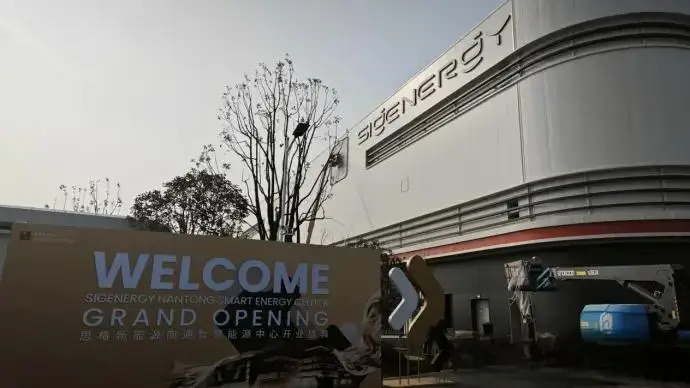
Visiting Sigenergy – a trip worth taking
I did two things on this trip: had two deep conversations with Tony, Sigenergy’s CEO, and toured their new Nantong factory and showroom. I don’t write press releases. Just real observations.
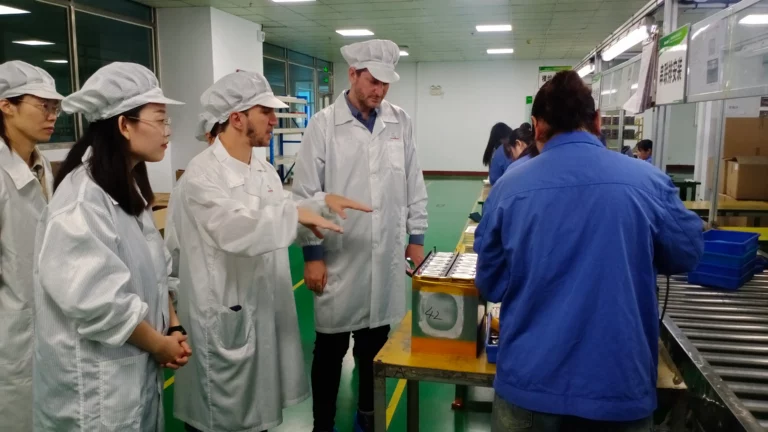
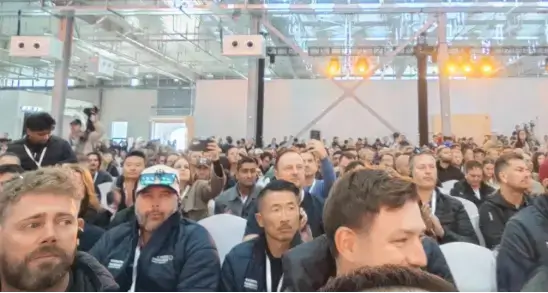
I’ve visited many top energy storage factories. Honestly, Sigenergy’s new facility is the largest and most advanced distributed storage factory I’ve seen. The event scale was unprecedented – nearly 2,000 attendees, about 90% foreign customers. Every continent except Antarctica was represented.
At the factory entrance, I saw a huge screen. My inner reaction was “Wow.” That’s the company’s operational brain – they call it the “Sigenergy Smart Energy Center.” Unfortunately no photos allowed.
What’s so great? They’ve built a digital twin that visualizes everything from materials to production to delivery. It’s likely integrated with EMS, ERP, CRM, PLM – truly “one screen to manage the world.”
That’s when I realized: calling it a “storage factory” sells it short. It’s really an “intelligent energy hub.” Production is just one function.
Let me spell out the hidden logic. Most companies build factories for capacity. Sigenergy builds a capability platform. Both are factories, but the ceilings are not the same.
Why I think Sigenergy has $100 billion potential
Back when I was in venture capital, I looked at nearly 100 companies a year and backed several that later went public with multi‑billion dollar valuations.
I have a habit of tracking those companies over time. After enough years, you develop a nose for where a business can go.
That nose doesn’t come from financial reports or grand strategic narratives. Honestly, every CEO’s vision sounds similar. The logic is usually the same.
I trust small, visible details – signals most people overlook. Strategy can be copied. Methodologies can be learned. But the consistency with which an organization handles thousands of tiny details – that’s very hard to fake.
When I pieced together what I saw at Sigenergy, I realized they are using an extremely disciplined certainty to hedge against the industry’s uncertainty – and riding the upside. That closed loop, from values to execution, is a real moat.
Detail 1 – Production started before the factory was finished
This sounds trivial, but it’s the most telling signal of all.
It says one thing directly: Sigenergy’s business is growing exponentially right now.
Their two Shanghai factories were already running at full capacity and couldn’t keep up with orders. So they had to start production in the new factory before the finishing work was complete.
Investors love this – it’s a classic leading indicator, a “good problem” of supply struggling to catch up with exploding demand.
Also, they went from first pile to topping‑out, finishing, and production in just eight months. Most companies simply cannot do that.
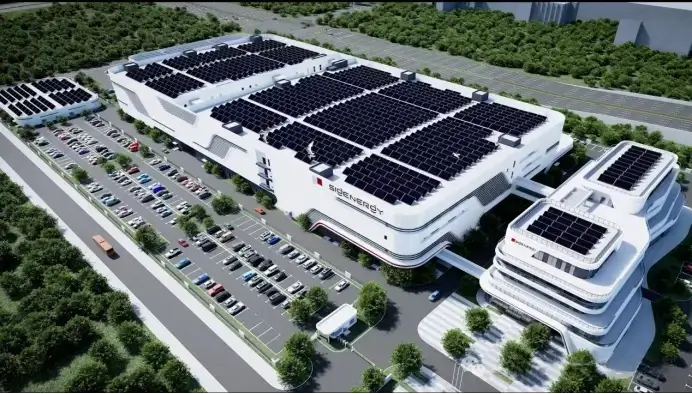
That speed isn’t just “hard work.” It means the construction team, finishing team, and equipment team all moved in parallel. Anyone who knows project management understands how complex that is – one weak link, and eight months would be impossible.
So this detail actually reveals Sigenergy’s exceptional organizational capability. That’s the thing many companies overlook, yet it largely determines how high you can fly.
At lunch, I chatted with one of their regional marketing heads. Sigenergy is growing hundreds of percent annually. The core team went from 4 people to 1,500 in three years. Despite that hyper‑growth, they keep everyone – different backgrounds, different systems, different stage goals – aligned on one big objective.
That means they have fully integrated L2C, IPD, the “iron triangle,” and channel management. Anyone who has run organizational transformation knows that each of these systems takes painful effort to embed.
But it’s worth it. Once the system runs smoothly, the late‑stage power is astonishing.
Detail 2 – Water dispenser, elevator, floor paint – taste in the details
These three things together tell the same story: Sigenergy’s aesthetic sense and management granularity.
At the CEO meeting, while everyone else asked about industry trends and grand strategies, I was the only person who publicly asked Tony about the water dispenser, the elevator, and the floor paint.
Why? Because I believe those little things reveal a company’s real taste and attention to detail.
Water dispenser – They use a GE unit. Tony told me they went through several models before settling on this one. The deciding factor? A tiny detail: the hot and cold water come out of the same spout. That means when you hold your cup, you don’t have to move left or right – one motion saved. For that one saved motion, they thought it was worth the extra effort. That’s Sigenergy’s obsession with user experience, externalized.
Elevator – Most people focus on the production line. I look at the elevator lobby. Sigenergy’s office elevator has marble flooring and back panels that would look at home in a six‑star Dubai hotel. Their aesthetic standard is high. If a company has no aesthetic sense for the environment they work in every day, how could they make a product as elegant as the SigenStor?
Floor paint – I’ve seen countless factories. Most use ugly green or grey epoxy that looks cheap. Sigenergy’s workshop floor is immaculate. I don’t know the exact material, but the flawless finish and solid feel tell customers: “This is a place that produces quality.”
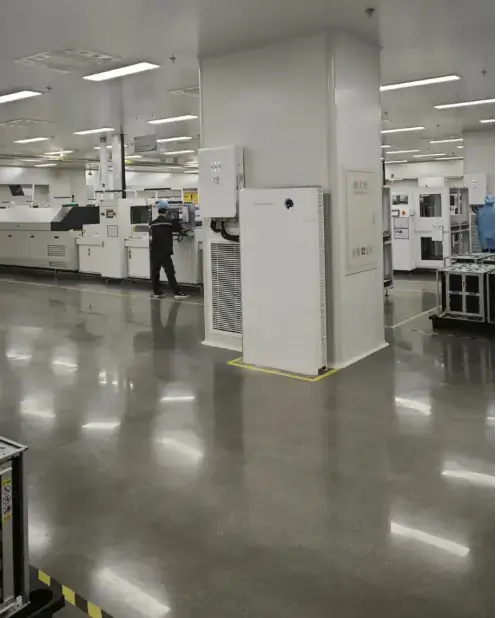
You might think: “So what? Just spending more money.” Let me explain my logic.
If a company can take non‑core assets like a water dispenser, an elevator, and floor paint seriously – refusing to compromise – then their rigour on core product definition and supply chain will be even higher. Never lower.
That’s a philosophy and a value system made visible.
Detail 3 – What you see vs. what you don’t
Walking through the production line, I noticed different levels of understanding.
Most people walk in, see the SMT machines and robotic arms, and go “wow” – then start snapping photos. For them, those machines represent the ceiling of modern manufacturing.
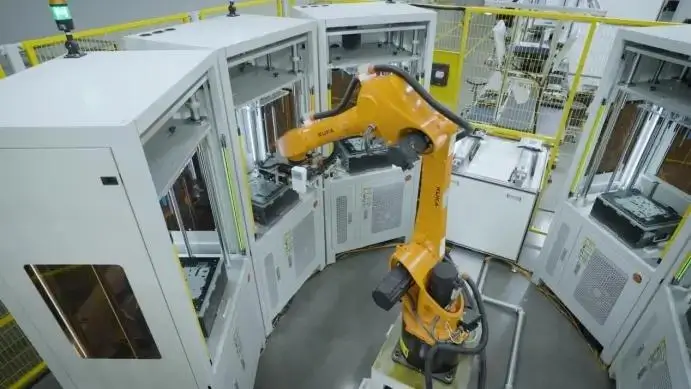
But look deeper.
The more professional crowd asks about data: tact time, yield, DIP automation, aging test protocols. On those metrics, Sigenergy’s numbers are impressive – one inverter every 21 seconds, one pack every 15 seconds. That’s industry‑leading.
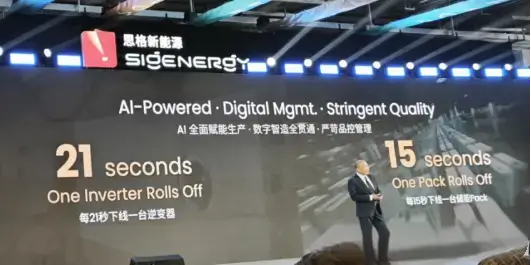
But even that misses the real story.
The true insider looks at the software integration – the invisible layer. That’s the iceberg below the waterline.
Why? Because many factories today have good hardware automation, but they also have information silos. MES handles production, WMS handles warehouse, PLM handles products, ERP handles resources – they don’t talk to each other. That creates manual handoffs, hurting efficiency and quality.
From my conversation with Tony, Sigenergy planned for this from the start. Their production lines are highly flexible, covering all current power classes and leaving room for future expansion.
More importantly, MES, WMS, ERP are not just “parallel” systems. They are deeply coupled through a unified data platform, with AI assisting at every production step.
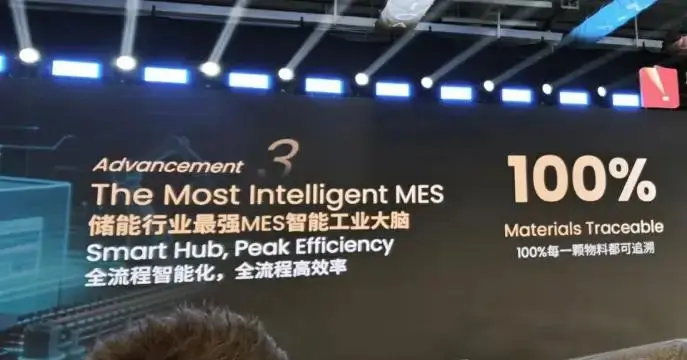
What does that achieve? Once a production order is released, material withdrawal, equipment parameter tuning, and process changeovers are all driven automatically by the system. No manual coordination needed.
That’s how Sigenergy gets both extreme efficiency and extreme quality – at the same time.
Overlapping suppliers – how does Sigenergy differentiate?
Walking through the showroom, one question kept coming back.
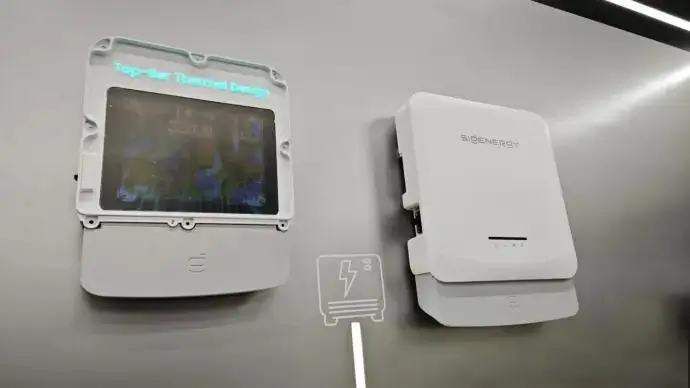
The upstream supply chain in this industry is largely overlapping. We all buy cells, chips, IGBTs, structural parts from the same handful of suppliers. The raw materials are almost identical.
So if everyone buys the same ingredients, how does Sigenergy cook a completely different dish?
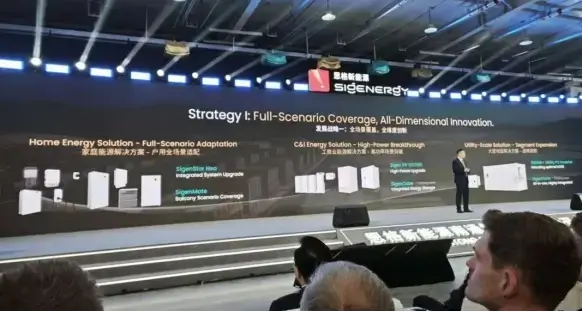
Looking at their new products:
- 9.9cm thin residential inverter
- 0.8C high‑rate battery
- 506kW grid‑tied string inverter
- New SigenStor Neo all‑in‑one
- Household‑grade microgrid distribution cabinet
- SigenTerra utility‑scale all‑in‑one
These products reflect a product definition logic that deserves its own separate article.
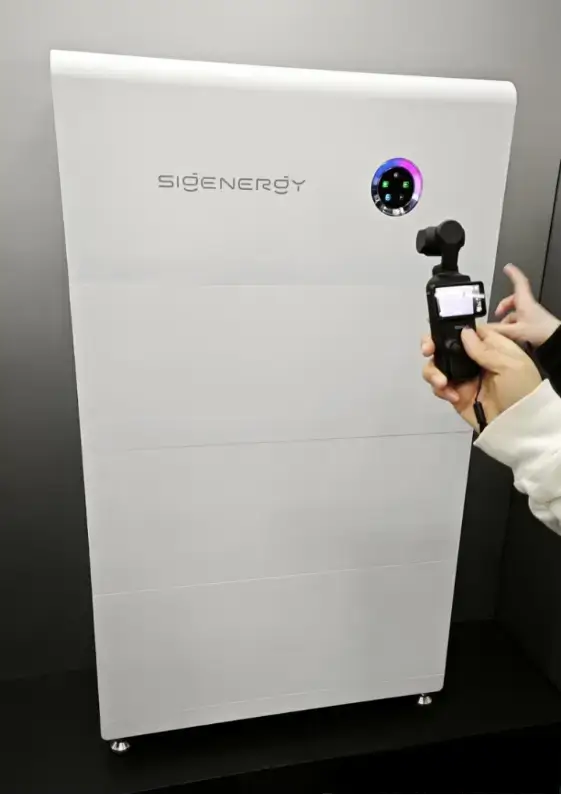
Where does that sharp product sense come from? Tony mentioned something that stuck with me: as an engineer by background, he genuinely enjoys going to the front line – not as a CEO making appearances, but visiting small towns even salespeople rarely go to, to see what customers are actually using, what they’re missing, where their real pain points are.
Then he comes back and pulls together R&D and product definition teams, turning those field insights into real product features. He enjoys that process.
This is exactly my point: depth of understanding of front‑line needs determines the precision of product definition, which determines a company’s momentum.
Closing – not one point of excellence, but systematic excellence
At the end of the event, Tony’s closing line stayed with me:
“The future comes slowly, hesitatingly, the present flies like an arrow, and the past stands still forever.”
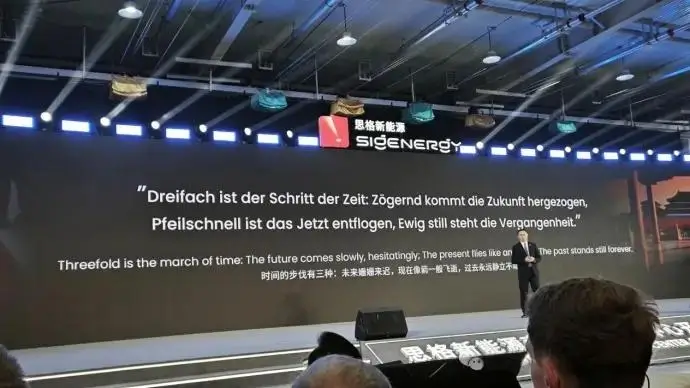
After watching many companies, I’ve learned that the real gap is created by those who build key capabilities before time gives them the answer.
What makes Sigenergy special is that through strategy and organisational strength, they are building brand, channel, product, R&D, manufacturing, software, AI, and globalisation simultaneously – each reinforcing the others.
Once a company like that crosses the tipping point, growth is no longer linear extrapolation. It becomes systemic release.
In Sigenergy, I’ve already seen that power moving in sync with time.